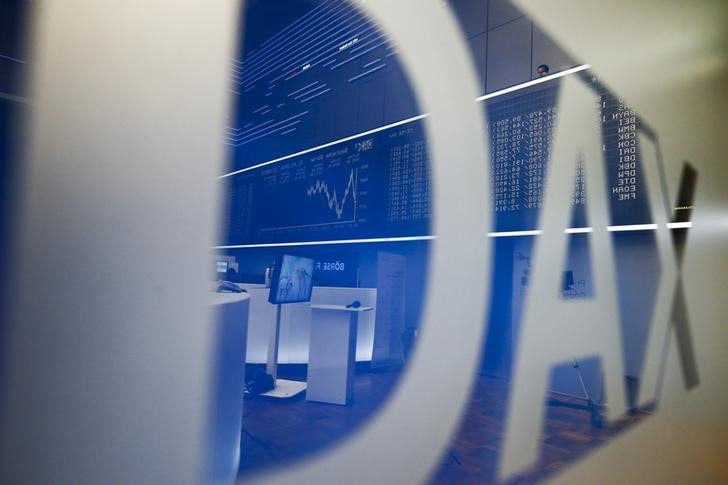
European stocks slipped slightly lower Wednesday, as investors digested a flood of corporate earnings while cautiously awaiting the latest interest rate decision from the U.S. Federal Reserve.
At 03:02 ET (08:02 GMT), the DAX index in Germany dropped 0.1% and the CAC 40 in France slipped 0.5%, while the FTSE 100 in the U.K. traded largely unchanged.
Subscribe to InvestingPro for detailed stock market analysis Fed meeting prompts caution Investors in Europe have shown a degree of caution ahead of the Federal Reserve’s interest rate decision later in the day, even as strong gains in technology and AI-related shares ahead of key U.S. megacap earnings lifted the benchmark S&P 500 index to record highs on Wall Street overnight.
The U.S. central bank is widely expected to keep interest rates unchanged later on Wednesday, and thus investors will likely focus on Chair Jerome Powell’s remarks for clues on the timing of potential rate cuts later this year.
Additionally, Powell’s term ends in May, and U.S. President Donald Trump said on Tuesday he will announce his pick for the new head of the Federal Reserve soon.
Trump has repeatedly pressed Powell to cut interest rates sharply, criticising the Fed head by claiming that he has been too slow in easing rates, creating concerns that his appointment of a replacement will result in a watering down of the independence of the central bank.
German consumer sentiment rises The mood among German consumers is set to improve in February, as the forward-looking GfK consumer sentiment index rose to -24.1 points in February from -26.9 points the month before, beating the expectations of a slight rise to -26.0 points.
The European Central Bank meets next week, and is widely expected to keep rates on hold at 2% for a fifth consecutive meeting with eurozone inflation remaining restrained and the region’s economy having proven more resilient than expected.
That said, ECB policymakers may need to consider another interest rate cut if further gains in the euro start to weigh on inflation, Austrian central bank governor Martin Kocher said in an interview with the Financial Times on Wednesday.
The euro rose to a more than four-year high on Tuesday as the dollar weakened amid investor concerns over U.S. policy risks and geopolitical tensions.
ASML expresses confidence for 2026 Turning to the corporate sector, the earnings season has kicked into top gear in Europe, with ASML (AS:ASML) in the spotlight after the Dutch chipmaking equipment supplier beat fourth-quarter forecasts and offered upbeat guidance for 2026 after reporting a jump in orders. This has pointed to continued demand from makers of advanced chips used in artificial intelligence.
Volvo (ST:VOLVb) reported a smaller-than-forecast decline in fourth-quarter operating profit, but the Swedish truckmaker cut its overall annual dividend payment by more than expected.
Swiss contract drugmaker Lonza (SIX:LONN) projected 2026 sales growth of 11%-12% in constant exchange rates with core EBITDA margins expanding above 32%, maintaining strong momentum despite foreign exchange headwinds.
Wacker Chemie (ETR:WCHG) reported fourth-quarter earnings below expectations and the German chemicals maker provided limited details on a €300 million cost-cutting program.
Late Tuesday, LVMH (EPA:LVMH), the world’s largest luxury group, beat fourth-quarter sales forecasts, boosting hopes of a luxury sector rebound even as trade tensions, a weaker dollar and high gold prices squeezed margins.
There are also some major companies reporting on Wall Street, with tech giants Meta Platforms (NASDAQ:META), Tesla (NASDAQ:TSLA) and Microsoft (NASDAQ:MSFT) all set to release quarterly earnings after the close.
U.S. winter storm in spotlight Oil prices mostly maintained recent gains Wednesday, as trader reacted to the severe winter storm in the U.S..
Brent futures slipped 0.1% to $66.50 a barrel and U.S. West Texas Intermediate crude futures rose 0.1% to $62.45 a barrel.
Both benchmarks surged about 3% on Tuesday, after closing at the end of last week at their highest points since January 14.
Estimates suggest U.S. producers lost up to 2 million barrels per day, or roughly 15% of national output, as the storm disrupted energy infrastructure and power grids.