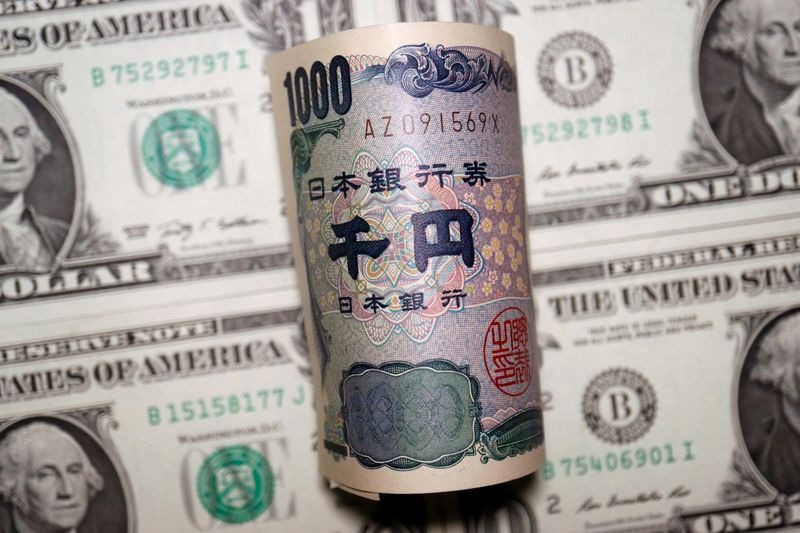
Most Asian currencies fell on Tuesday, with the Japanese yen sliding to a one-year low, as rising oil prices driven by unrest in Iran weighed on the region, while fresh U.S. political and trade developments dented investor confidence.
The US Dollar Index, which measures the greenback against a basket of major currencies, edged up 0.1% after slipping modestly in the previous session.
US Dollar Index Futures also traded 0.1% higher as of 03:36 GMT.
Unlock expert analysis on Asian currencies, analyst research with InvestingPro subscription Japanese yen hits 1-yr low amid snap election reports The Japanese yen was the top loser, with the USD/JPY pair rising 0.4% to 158.76 yen, its highest since January 2025.
The currency was pressured by reports that Japanese Prime Minister Sanae Takaichi may call a snap election as early as February.
Market participants speculated that an election victory could help Takaichi secure a stronger mandate for expansionary fiscal policy, adding to downward pressure on the yen.
Trump tariff threat, Iran unrest, rising oil prices in focus Risk sentiment across Asia remained fragile after U.S. President Donald Trump said Washington would impose a 25% tariff on goods from countries “doing business” with Iran, without providing details on the scope or timing of the measure.
Oil prices continued to climb after deadly anti-government protests in Iran raised fears of potential supply disruptions. The unrest has prompted warnings of possible military action from Trump, adding to geopolitical risk premiums.
"Asian currencies might have been negatively impacted by recent increases in oil prices including developments in both Venezuela and Iran," MUFG analysts said in a note.
"Beyond China, the likes of Turkey, United Arab Emirates, and to a smaller extent Russia and India have some trade linkages with Iran," they added.
Back in Asia, the South Korean won’s USD/KRW pair also gained 0.4%, rising for the seventh straight session.
The Indian rupee’s USD/INR pair edged up 0.1%, while the Singapore dollar’s USD/SGD traded flat.
In China, the yuan’s onshore pair USD/CNY was little changed, while the offshore pair USD/CNH ticked 0.1% higher.
The Australian dollar’s AUD/USD pair traded largely unchanged.
Fed independence worries spark risk-off mood The Trump administration has opened a criminal investigation into Federal Reserve Chair Jerome Powell over his testimony about renovation works at the central bank’s headquarters, raising concerns around the Fed’s independence.
Powell, in a statement, defended the Fed’s autonomy and said policy decisions would continue to be guided solely by economic data and the central bank’s mandate. Several former Federal Reserve chairs and senior officials publicly voiced support for Powell.
"It’s wait-and-see mode now as markets try to assess the effective implications of all this," ING analysts said in a recent note.
Despite the softer dollar, Asian currencies struggled to benefit as investors focused on the broader implications of U.S. political risk, trade uncertainty, and rising oil prices.