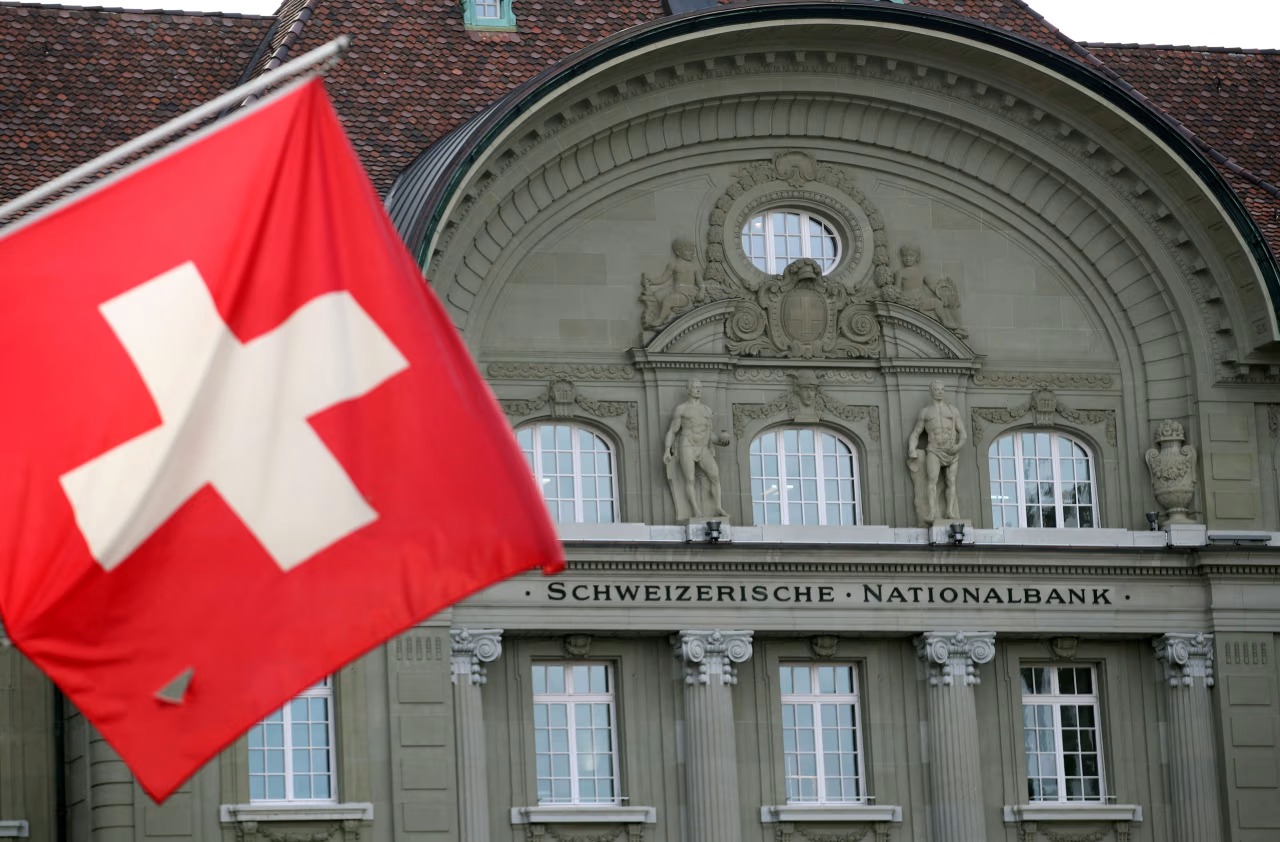
Below are the main points from the interest rate statement issued by the Swiss National Bank: The Swiss National Bank kept the key interest rate unchanged at 0%, compensating demand deposits at the same rate up to a certain limit, while the discount on excess deposits remains at 0.25 percentage points. The bank confirmed its readiness to intervene in the foreign exchange market if necessary.
There was no significant change in inflationary pressure compared to the previous quarter, as monetary policy helps keep inflation within a range consistent with price stability and supports economic development, with the Swiss National Bank confirming that it will continue to monitor the situation and adjust monetary policy if necessary.
Inflation has seen a slight rise since the last assessment, increasing from -0.1% in May to 0.2% in August, primarily attributed to inflation in the tourism sector and imported goods.
Despite the slight increase, inflationary pressure has not changed much compared to June, with inflation expected to be slightly higher in the short term, but the conditional medium-term forecasts remained stable within the price stability range throughout the forecasting horizon.
The average annual inflation is still projected at 0.2% for 2025, 0.5% for 2026, and 0.7% for 2027, assuming that the Swiss National Bank's interest rate remains at 0% throughout the forecasting period.
Global economic growth slowed in the first half of 2025, affected by US tariffs and high uncertainty, while the Swiss National Bank expects weak growth for the global economy in the upcoming quarters.
Inflation is likely to remain high in the United States for some time, while it is expected to stay close to the target level in the Eurozone.
The global scenario remains subject to a significant degree of uncertainty, with the possibility of further trade barriers being raised, which could lead to a clearer slowdown in the global economy, while it is not excluded that the global economy may show resilience beyond expectations.
In Switzerland, economic growth was weak in the second quarter, with GDP not exceeding 0.5% after strong growth in the first quarter, driven by the pharmaceutical sector, which experienced sharp fluctuations due to earlier product delivery dates to the United States.
The services sectors supported the Swiss economy in the second quarter, but unemployment rates have risen further in recent months.
The economic outlook for Switzerland has deteriorated due to high US tariffs, which are likely to weaken exports and investment, particularly in the machinery and watchmaking sectors, while its impact on other sectors such as services has remained limited so far.
The Swiss National Bank expects GDP growth to range between 1% and 1.5% for 2025, and less than 1% for 2026 due to tariffs and high uncertainty, with unemployment continuing to rise.
The economic forecasts for Switzerland remain ambiguous, with the main risks being US trade policy and global economic developments.