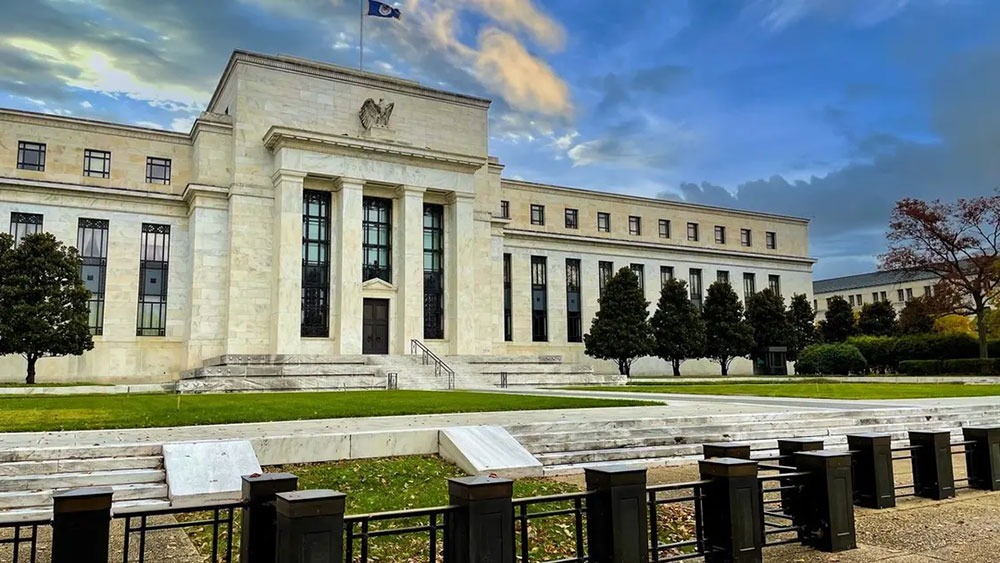
Key Points The US Federal Reserve meeting will determine the monetary policy direction for this year amid global anticipation. US inflation and labor market data exert mixed pressures on the interest rate decision. Markets favor a rate cut of 25 basis points while monitoring the tone of Jerome Powell’s press conference. Global markets are focused on the US Federal Reserve meeting, which is considered the most significant this year, with critical anticipation for the interest rate decision and monetary policy statement, alongside the press conference of Fed Chair Jerome Powell. This meeting represents a pivotal moment for determining the direction of the US dollar and the bond market, with a direct impact on gold, oil, and cryptocurrencies prices for the remainder of the year.
Markets await any signals regarding the trajectory of US interest rates for this year and next, especially in light of President Donald Trump's pressures to aggressively cut rates to support economic growth and employment. Below is an overview of the circumstances surrounding the decision-making within the US Federal Reserve:
First: US Economic Data Pressures the Decision In recent times, US inflation indicators showed a slight acceleration, with the annual inflation rate rising to 2.9% in August from 2.7% in July. The monthly Consumer Price Index increased by 0.4%, surpassing market expectations. This increase heightens concerns about the persistence of inflationary pressures, complicating the Fed's task of stabilizing prices.
Conversely, the labor market report was disappointing, with the US economy adding only 22,000 jobs in August against expectations of 73,000, while the unemployment rate rose to 4.3% from 4.2%. These figures highlighted the fragility of employment under the influence of high interest rates.
On the consumer spending front, the personal consumption expenditures index recorded an increase of 0.3% in July for the second consecutive month, reflecting relative stability in household consumption despite challenges.
This economic data reflects a slight rise in inflation, stability in consumer spending indicators, alongside the weak state of the US labor market in recent months, which may prompt the US Federal Reserve to move forward with the option of lowering rates in this meeting, especially with President Trump's calls for the Fed to immediately start reducing rates aggressively.
Second: Market Expectations for the Interest Rate Decision The CME FedWatch tool indicates that markets expect a 96.1% chance that the US Federal Reserve will reduce rates by 0.25% in this meeting, while the chance of a 0.50% cut stands at just 3.9%. This scenario reflects the Fed's movement towards a rate cut.
In a recent note, Bank of America analysts predicted that the Federal Reserve will cut interest rates this week and then wait until December before implementing another cut.
Additionally, Crédit Agricole noted that the Federal Reserve is widely expected to cut interest rates by 25 basis points during its meeting this week, but at the same time warned that the decision could carry a hawkish or contractionary tone.
Moreover, Deutsche Bank predicted that the US Federal Reserve will implement three consecutive interest rate cuts during its upcoming meetings in September, October, and December of this year, by 25 basis points each meeting, marking a notable adjustment from its previous expectations of just two cuts in September and December.
Third: Officials' Statements from the Federal Reserve on the Interest Rate Path The tone of recent statements from Federal Reserve officials has been cautious, with hints towards a rate cut. Federal Reserve Chair Jerome Powell said at the Jackson Hole Forum in August that recent data necessitates a change in the current monetary policy stance.
Likewise, Chicago Fed President Austan Goolsbee expressed hesitation about whether September is the right time to cut interest rates, following data showing continued weakness in the labor market.
John Williams, President of the New York Federal Reserve, affirmed that interest rates are likely to decline but at a slow pace. He pointed out that the Federal Reserve's dual mandate still imposes the need to carefully balance supporting the labor market through rate cuts while keeping inflation under control through a more restrictive monetary policy.
Meanwhile, Neel Kashkari, President of the Minneapolis Federal Reserve, confirmed that the US central bank still has significant work to do to bring inflation back to the target level of 2%, adding that the anticipated split among Fed members' votes during the September meeting will reflect this difficult balance.
Possible Scenarios and Market Reactions Scenario One: If the US Federal Reserve decides to cut rates by about 25 basis points (likely) or by about 50 basis points (unlikely), but the interest rate statement and the chair's press conference may affirm the bank's comfort with falling inflation and a slowing labor market, potentially leading to further cuts in the future. This scenario could lead to a decline in the US dollar and an increase in gold prices, US stock indices, and Bitcoin.
Scenario Two: If the Federal Reserve opts to cut rates by about 25 basis points (likely) or by about 50 basis points (unlikely), while the statement and the chair's press conference indicate that this decision will not be followed by additional cuts in the near future until more economic data supporting this path is released. In this scenario, the US dollar may rise, followed by an expected decline in both gold prices and US stocks as well as cryptocurrencies, especially Bitcoin.